Is Panama City Beach a Good Vacation Rental Investment Right Now?

As we come out of summer, owners start looking at their vacation rental revenue and evaluating their investments. Every week someone asks me a version of the same question: "Is Panama City Beach still a good place to buy a vacation rental?" Most of the answers floating around are useless.
Some answers are from real estate agents telling you what you want to hear so they can make a sale. Some are from management companies doing the same thing. Some are from self-proclaimed vacation rental “gurus” who lack any experience, credentials, or real-world knowledge and only give you half the information. None of them are correct.
So here is the data for Panama City Beach by itself, with data presented from August 2026. Some of them are better than you would expect. Some of them should give you pause.
The short answer
Buying conditions are better than they were a year ago. Revenue conditions are property-specific, and that is where deals are won or lost.
You are buying into a market with less competition than last summer and sellers who are still negotiating. What you cannot do is assume the revenue. The spread between a well-run property and a poorly-run one on the same street is wide enough to swallow your entire return.
What the market actually did
These are Panama City Beach residential numbers only, pulled from the MLS on September 25, 2026. August is a closed month, so these are final.
|
METRIC |
AUG 2026 |
AUG 2025 |
CHANGE |
|
Median sale price |
$399,500 |
$429,900 |
−7.1% |
|
Closed sales |
172 |
183 |
−6.0% |
|
Active listings |
1,575 |
1,849 |
−14.8% |
|
Sale-to-original-list |
91.6% |
91.5% |
flat |
|
Average days on market |
96 |
88 |
+8.9% |
Now the year-to-date figures, which matter more than any single month:
|
METRIC |
2026 YTD |
2025 YTD |
CHANGE |
|
Closed sales |
1,484 |
1,258 |
+18.0% |
|
Median sale price |
$420,000 |
$420,000 |
0.0% |
|
New listings |
2,666 |
2,923 |
−8.8% |
Read those two tables together and the story is not the one the headline number tells. Inventory on the beach is down almost 15%. Fewer new listings are coming. Sales are up 18% year over year. And through all of that, the median sale price is exactly where it was a year ago: $420,000.
But the most useful number is not in either table, because averaging it destroys its integrity.
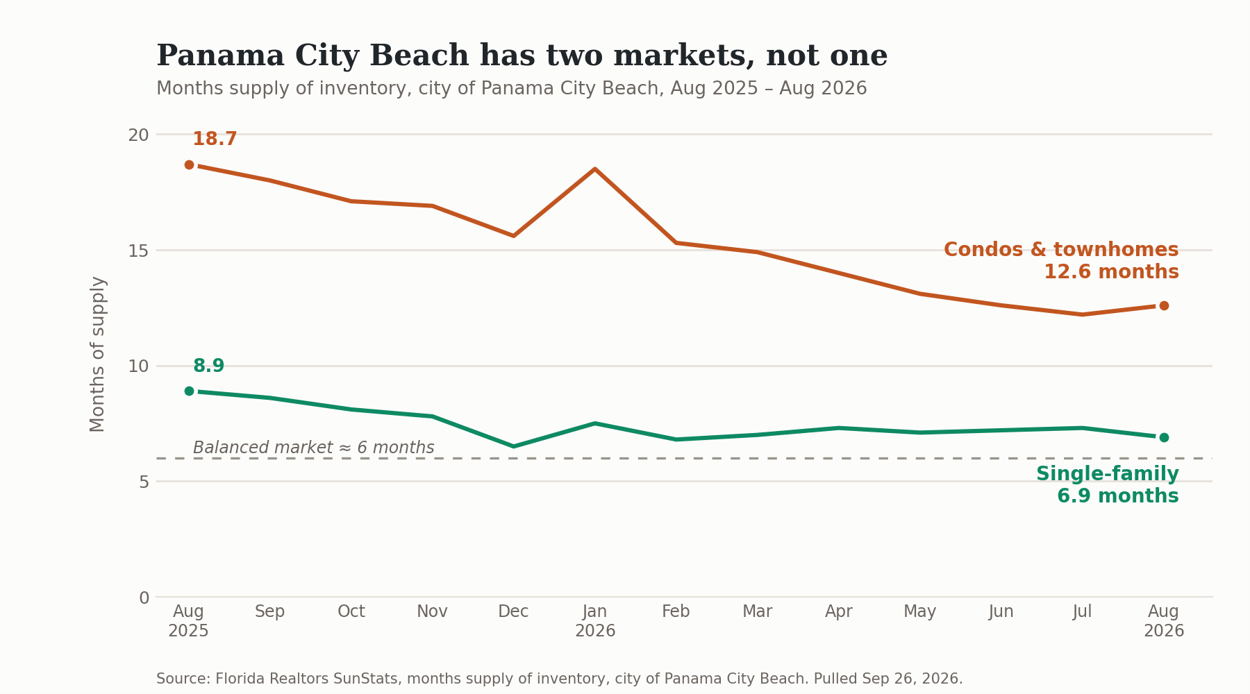
Panama City Beach is two markets, and the average hides it
Months supply of inventory is the cleanest measure of who has leverage. Under roughly six months favors sellers, over 6 months favors buyers. Examining it for Panama City Beach as a whole and you get an inaccurate picture of the market.
|
MONTHS OF SUPPLY |
AUG 2026 |
AUG 2025 |
CHANGE |
|
Single-family |
6.9 |
8.9 |
−2.0 months |
|
Condos and townhomes |
12.6 |
18.7 |
−6.1 months |
Single-family properties are at 6.9 months supply of inventory and knocking on the door of a balanced market. Condos and townhomes are at 12.6 months, nearly double, and the loosest segment on the beach by a wide margin.
Both improved over the year. Condos improved more in raw terms, falling 6.1 months, but they started at 18.7, which is deep buyer’s-market territory. And the improvement has stalled: condo supply bottomed at 12.2 months in July and ticked back up to 12.6 in August, while single-family kept tightening to its lowest reading since December.
This is the practical takeaway of the whole post. If you are buying a single-family property on the beach, you might be competing with other buyers. If you are buying a condo, you have leverage and time, and you should be using both.
So why did August’s median drop 7%?
Because the mix moved, not because values fell. That is my read, and here is what it rests on: in August, the $500,000-and-up band closed 55 properties against 69 a year earlier, down 20%. Meanwhile the $200,000s and $300,000s closed more than they did last August.
When fewer expensive properties close in a given month, the median falls even if nobody’s value changed. Year to date, closings are up in every price band, including $500,000-plus, which is running 489 against 441 last year. One month of thinner higher-end closings is just a mixed shift.
What the numbers mean when you write an offer
Three things stand out for a buyer right now.
Sellers are still taking real reductions. The sale-to-original-list ratio in August was 91.6%, essentially unchanged from 91.5% a year ago. The typical beach seller is signing roughly 8% below their original asking price. That discount is the normal rhythm of this market, and it should be in your model before you fall in love with a listing. Every neighborhood and building performs differently though, so be sure to ask your agent for your specific data sets when preparing to write an offer.
Properties still sit. Average days on market was 96, up from 88 last August. Median cumulative days on market was 72, up from 57. A property that has been listed since spring is not a bargain by default, but it is a conversation.
Your leverage depends on the segment. At 6.9 months, single-family is close enough to balance that a well-priced property will move. At 12.6 months, a condo seller has far more competition than buyers do, and your offer should reflect that. Both numbers are better than a year ago, which matters if you are thinking about waiting another twelve months for a better entry.
Where the returns actually come from
Purchase price is the part everyone argues about. Revenue decides whether the deal works, and it is the part almost nobody underwrites honestly. Three things to get right before you sign anything.
- Know the difference between nightly gross and total gross. A seller’s revenue number often includes cleaning fees and collected taxes, which never reach the owner. I wrote a whole breakdown of this with an infographic, and it is the single most common way a pro forma gets inflated. Link to the Explanation of Nightly Gross vs. Total Gross post.
- Rebuild the pro forma from actual booked nights. Not projections, not a management company’s estimate, not an app’s guess. Booked nights, by month, at the rate that was actually collected. If a seller will not provide that, you have learned something. Take into consideration owner use during peak holidays and maintenance blocks.
- Underwrite the shoulder season, not the summer. Almost every property on this beach makes money in June and July. What separates a working investment from a break-even one is what it does in October, February and April.
Condo or single-family, and can you finance it?
The supply split tells you where the negotiating room is. It does not tell you which one earns more, and those are different questions.
What I see across the properties we manage is that a single-family property with something the listing next door does not have (like a private pool, a fenced yard for pets, a boat slip, walkability to a specific stretch of beach) tends to hold its rate in the shoulder season better than a comparable condo, because there is no identical property three floors up competing on price. In a condo building, two hundred properties are selling the same view.
The exception is a fully remodeled condo and I mean fully remodeled! A property that has been genuinely updated, not just a new microwave after twelve years, with decor distinct enough to photograph differently from its neighbors, competes against its own building on quality instead of price. That changes the rate it can hold.
But there is a second condition, and it is the one that decides most condo deals: how you pay for it.
Condo carrying costs stack up before a single dollar of debt service. Association dues, the master policy plus your own insurance coverage, and the assessment risk sitting behind the reserve study. In the deals I examine, the revenue premium a remodeled condo earns over an ordinary one in the same building is real, but it is rarely large enough to cover dues, insurance and a mortgage payment and still leave the owner a decent return. The condo purchases that work are usually cash purchases, where revenue only has to clear dues, insurance, taxes and management.
Single-family with a genuine differentiator behaves differently. A private pool, a boat slip, a fenced yard steps from a specific stretch of beach; those carry a rate premium in the shoulder season, when a condo is discounting to fill. That premium is often enough to absorb a mortgage payment and still leave the numbers standing, which means a financed buyer can make it work.
Put plainly: if you are financing, a single-family property with a real amenity is usually the more workable path on this beach. If you are buying a condo, plan on paying cash and on remodeling it to a standard its competitors cannot match. This is the expectation to ensure the math works.
Two honest caveats: cash is not free. The money has an opportunity cost, and a cash condo with a modest yield may still lose to a financed property with less of your capital in it. And leverage cuts both ways: the same mortgage that makes a good single-family deal excellent makes a marginal one painful in a soft October.
Run that comparison before you pick a category. The segment with the most inventory is also the one where the wrong property sits and the right one prints.
The costs that break the math
This is where beach investments most often disappoint. It is the same five line items every time.
- Wind and flood on the coast, and it is not a fixed number year to year. Quote the specific property before you go under contract.
- Association dues and assessments. On a condo, dues are the visible cost and special assessments are the one that hurts. Read the reserve study and the last two years of meeting minutes. Florida’s structural inspection and reserve funding requirements have reshaped budgets in older buildings, so confirm where your building stands on both before you buy.
- Property taxes after the sale. A non-homestead property is reassessed, so the seller’s tax bill is not the one you will pay. Model it at your purchase price.
- Management and turnover. Self-managing from out of state costs more than people think, usually in vacancy, maintenance issues, and reviews rather than dollars.
- Maintenance and salt air. HVAC, exterior finishes and anything metal age faster here. Budget it as a percentage of revenue and remember that everything wears out faster in a short-term rental. Stop comparing the couch in your house to the one in your rental.
The risks, stated plainly
If someone shares a post like this and only lists reasons to buy, close the tab – they don’t have your best interests at heart.
- Condo exposure. Older beach buildings carry real assessment risk, and 12.6 months of supply is partly the market pricing that risk in. A $40,000 special assessment erases several years of net income on a mid-priced property.
- Insurance volatility. A renewal that jumps materially can move a deal from working to marginal, and you do not control it.
- Regulatory change. Short-term rental rules are set at multiple levels and they do change. Verify what applies to the specific property, and what the association allows, in writing.
- Seasonality is severe here. This is a summer-weighted market. A model built on twelve equal months is a model built to fail.
- Supply of competing rentals. Your competition is not only other listings for sale, it is every other rental on the beach bidding for the same weekend.
How I would underwrite a PCB rental today
- Pull the actual booked nights and collected rates for the last 24 months. Projections are nice, but real data always wins. In the absence of data for a specific property (maybe it was never a rental), use comparable properties and blend the data together.
- Strip cleaning fees and collected taxes out of the revenue figure so you are looking at what reaches the owner.
- Quote insurance on that specific property, and taxes at your purchase price, not the seller’s tax bill from last year.
- On a condo, read the reserve study, the last two years of minutes, and the inspection status of the building. Ask questions!
- Model the shoulder season honestly, then subtract the weeks you plan to use it yourself. Owner blocks are fine, but understand every day you aren’t renting is potentially costing you money.
- Then decide what it is worth to you, and write the offer against the 91.6% reality rather than the asking price. Good seller’s agents have already shown their clients the data and prepared them for the inevitable: properties today (generally) aren’t selling at full list price.
So, is it a good investment or not?
On the buy side, conditions are more favorable than they were a year ago: inventory tightening rather than piling up, and sellers still moving roughly 8% off original list. Prices are flat year over year, which means you are not chasing a run-up and you are not catching a falling knife either. But answer it by segment. Single-family at 6.9 months is a market you compete in. Condos at 12.6 months is a market you negotiate in, with the building’s reserves and assessment history and individual condo condition doing more to decide your return than the purchase price will.
On the revenue side, the answer depends on the property and on how you are paying for it. A financed buyer is usually better served by single-family with a real amenity. A condo buyer should expect to pay cash and to remodel. There are buildings here where the numbers work comfortably and buildings a quarter mile away where they do not, and that difference never shows up in a market-level statistic.
If you want to run the numbers on a specific property, I will underwrite it with you: actual booked nights, real carrying costs, and what it means at the price you are considering. Click Here To Get In Contact With Me.
Data: sales and price figures from the MLS Market Summary, Residential, City of Panama City Beach, pulled September 25, 2026. Months supply of inventory from Florida Realtors SunStats, Panama City Beach, pulled September 26, 2026. Figures are for the Panama City Beach area only. This article is for general information and is not legal, tax or investment advice; consult your own attorney, CPA and insurance agent for your situation.
Categories
Recent Posts