A Local's Letter About Tourism Following Hurricane Isaias
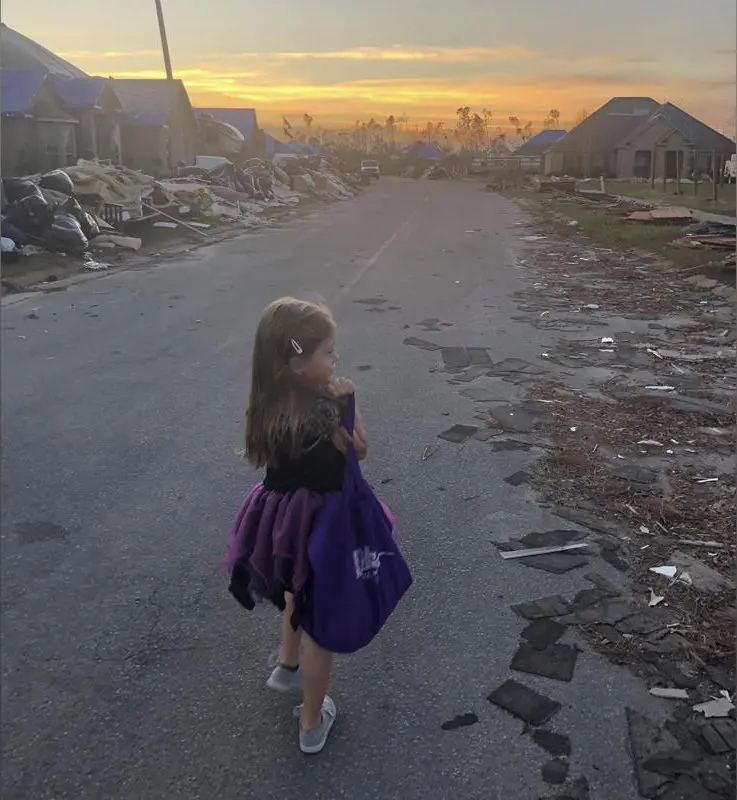
Image Source: Heather D'Agostino Piddington - Little girl trick-or-treating amid Hurricane Michael damage
Hurricane Isaias tore through Northwest Florida on October 9, 2026. Panama City Beach, overall, was lucky. We didn't experience the widespread devastation that our neighbors to the west did — much of 30A, Destin, Navarre, and Pensacola, and other communities dotted around our usually pristine Gulf-side area will feel Isaias' wrath for weeks and months to come. All across the western Panhandle, families and businesses are dealing with everything from damaged roofs, flooded houses, downed trees, and the heartbreak that comes with having to toil tirelessly cleaning it all up, only to come home at night to a building that resembles home, but is but a shell of it, or to temporary accommodations that don't feel like home at all.
And then there's the date — October 9th. The very next day — October 10th — when people carefully stepped over downed power lines and fallen trees to survey the damage to their properties, was the eighth anniversary of Hurricane Michael, a Category 5 monstrosity that tore through the eastern Panhandle in 2018. Michael quite literally changed the coast by pushing huge amounts of sand and earth, by ripping up entire swaths of pine forests, and erasing the physical family history of so many in the area. Call it a cruel coincidence, or cosmic irony. Whatever you want to call it, every one of us that remembers Hurricane Michael got a punch to the gut when Isaias decided to fly in on almost the same day.
Those of us who lived through Michael and its aftermath don't need to imagine what our neighbors to the west are facing — we remember, although many probably wish they didn't. Every storm meets the same ending: the eerie silence after the wind and rain stopped. The stars in the sky visible from your living room, looking up at what used to be your ceiling, peeled open like a pop top. And the days that followed saw once-unique houses blending together in the Great Blue Sea of tarps expanding out in every direction. The debris piles stacked so high on either side of the street, they towered over the cars driving. For a few weeks, these were our Florida mountains; mounds of trash and broken wood. The hours sitting in traffic to get gas, go to the laundromat, getting tire after tire patched from nails, and of waiting to get home to see if home was still waiting for you. I think for so many of us, Isaias wasn't just a storm, but a memory — no, a nightmare — from eight years ago clawing its way into your thoughts.
I've been watching conversations unfold online over the last few days, and I want to be clear about this first: I understand where the "stay away" posts from locals towards tourists are coming from. When your community is in trouble, the last thing you want is a crowd of gawkers and beachgoers getting in the way of the emergency responders and linemen doing their jobs. Roads need to stay clear for crews to get to where they need to be and get the job done. Accommodations, vacation rentals and hotels alike, are needed for displaced families or workers coming to the area. Grocery stores and gas stations, already running thin on supplies, need to be available for local families to get what they need, when they need it, and first responders are stretched as thin as it gets.
I don't think the people posting these messages online are being unkind; quite the opposite in fact. I think they're tired, scared, worried, and they're trying to protect what's left of their home. I believe they're also thinking of our visitors’ enjoyment. Many restaurants, attractions, and businesses are closed and may not reopen for months, if at all. The sandy beach itself is in disarray and messy, possibly hiding dangerous debris under its sugar-white sands. Our visitors may not enjoy their time here if they come, and I think our locals are trying to tell them that. Many tourists are asking on social media if a particular neighborhood or condo building has power, and this is upsetting some locals who respond in a less-than-hospitable way. But remember, many of our visitors have no idea what kind of devastation a hurricane brings, just as we are fortunate not to deal with catastrophic wildfires often in our area, or earthquakes that shake your soul. Our visitors are not trying to make light of our tragedy; they just don't know how bad it can be post-hurricane.
And there's another side to this that matters just as much.
I was born here. I went to school here. I grew up here. I worked in the community as a police officer here. I still live here, and I own businesses here. This same story can be told by thousands of other locals just like me, a huge number of which make their livelihood in industries directly tied to tourism.
The property manager looking after the properties that tourists or even displaced families are staying in. The housekeeper that cleans vacation rentals. The line cook at your favorite hangout. The bartender that knows the name of everyone in your family but also remembers the returning tourists that visit every year from Tennessee. The charter captain, the beach chair delivery guy, the maintenance tech, the server, the Uber driver, the photographer, the gift shop owner who mortgaged her house to finance her dream on the beach. Every single one of these people depends on a supply of guests to help pay their bills. When the visitors stop coming, it is we, the locals, that will feel it the hardest.
I'll tell you where I stand on this issue. After Michael, so much of our region was destroyed and thousands of jobs disappeared overnight. Restaurants that once employed over a hundred people just ceased to exist, and those same people were now unemployed, adding a job to the ever-growing list of things that Michael took from them. So many of these now-unemployed people just up and left the area. People I grew up with that had lived here their entire lives just moved away to start fresh because everything they had here, including their means to rebuild, was gone.
In the days following Hurricane Michael, just as I've done in the days following Isaias, I've been in and out of properties, checking on them, assessing damage, getting repairs lined up, and doing my job. I spent hours speaking with guests, reassuring them that the property they booked is still standing and they can still come and enjoy it. And they did. Visitors kept coming, enjoying our area, eating in the restaurants that were open, spending money in the stores that could accept them, and staying in the properties that were habitable. And because they kept coming, I kept getting a paycheck. This is not an exaggeration — because of tourism, I had a job.
Tourism didn't just help me recover, it was the recovery, because without it, I'm not sure recovery would've been possible. And I'm not the only one with a story like this. Thousands of families, your neighbors, all over the Panhandle have a story just like mine.
A hurricane doesn't just hurt the places it hits. It also hurts the places nearby that it spares if the world decides that place is closed. Encouraging guests to cancel their vacations is hurting more families than you might realize, adding more hardship to someone counting on that money to help them rebuild.
Because of this, tourism dollars aren't separate from recovery — they are an integral part of it. Tourism spending pays the wages of so many locals in so many ways and allows those locals to repair, rebuild, and recover. And, in a broader sense, it funds a great deal of the tax base used to pay for our first responders that are sorely needed during disaster. A strong, steady economy here means more of us are in a position to help others.
So here's what I ask of locals and visitors alike.
To my fellow locals: let's extend the same grace and hospitality that our area is known for to our visitors. Most of our guests travel to our amazing beaches and see them for the first time, or what might be the only time, and yes, sometimes the last time. They love our area as much as we do, or they wouldn't be so upset when they can't come. If we welcome them kindly and show them the same compassion we show our neighbors, they will be understanding of what we're going through.
And to anyone planning a trip to the area: check conditions before you travel. Reach out to your host or property manager, see if the restaurant you made reservations at six months ago is even still standing. Respect closures and have patience; don't call somewhere back-to-back asking if they're open for happy hour. Stay out of the way of cleanup crews and try not to put strain on resources locals may need. If your destination is open for business, like Panama City Beach is, come on down. Eat at local restaurants, shop at local stores, and give your server a little extra grace if she seems like she has a lot on her mind. You are not a burden — you are the lifeline of many of us.
And if you want to do more, consider donating to a local relief organization supporting the communities affected.
This stretch of coast has endured many storms and we will, unfortunately, endure many more over the years, but we will always bounce back. Supporting families who are rebuilding their lives and families who are working and keeping our tourism economy moving does not have to be a choice - you can do both.
Categories
Recent Posts